In the rapidly evolving world of digital media, image formats are often the unsung heroes—or the hidden villains—of our online experience. If you’ve ever tried to upload a photo to a website, attach a logo to a professional document, or edit a graphic in Photoshop, you’ve likely encountered the “WebP” format. While it’s great for the internet, it often creates a “Format Not Supported” headache.
This is why the search for a reliable way to convert WebP file to PNG has skyrocketed. In this 3,000-word masterclass, we will explore the technical architecture of these formats, why conversion is necessary, and how to use PNGtoWebPConverter.io to bridge the gap between performance and compatibility.
Understanding the Modern Image Landscape
The Rise of the WebP Format
WebP was introduced by Google in 2010. Its mission was simple: make the web faster. In the early days of the internet, we relied on JPEGs for photos and PNGs for graphics. However, as mobile browsing became the norm, these file sizes became a burden.
WebP uses a sophisticated predictive coding technology (derived from the VP8 video codec) to compress images. It looks at neighboring blocks of pixels to predict the values in a block and then encodes only the difference. This makes WebP files roughly 25-34% smaller than comparable JPEGs or PNGs without a noticeable loss in quality.
The Persistence of PNG
If WebP is the future, why is PNG still the king? PNG (Portable Network Graphics) was born in the mid-90s to bypass the patent issues surrounding the GIF format. It is a lossless format, meaning it stores every single bit of data perfectly.
While WebP is optimized for delivery (getting the image to your screen fast), PNG is optimized for integrity (keeping the image perfect for editing and printing). This is the fundamental reason why users constantly need to convert WebP back to PNG.
Why Convert WebP File to PNG? (Key Use Cases)
To write a guide of this magnitude, we must look at the specific scenarios where a WebP file to PNG simply won’t cut it.
1. Legacy Software Compatibility
While modern browsers like Chrome, Safari, and Edge love WebP, many desktop applications are stuck in the past. Older versions of Adobe Creative Suite (specifically pre-2022 Photoshop), Microsoft Office 2016, and various specialized medical or engineering software cannot “read” a WebP file to PNG. Converting to PNG is the only way to open these assets.
2. Professional Printing Requirements
Printers require high-density data. Because WebP is a “lossy” format by default in many web implementations, the compression artifacts—though invisible to the human eye on a screen—can become glaringly obvious when printed on a high-resolution canvas or glossy paper. PNG provides a stable, lossless foundation for print.
3. Transparent Design Assets
Both formats support transparency, but PNG is the industry standard for “Source Files.” If you are a logo designer, providing a client with a .webp logo might look unprofessional because they won’t be able to drop it into a Word document or a PowerPoint easily. A .png with a transparent background is the “universal” expectation.
4. Social Media Upload Constraints
While Facebook and Instagram have updated their backends, many niche social media platforms, forums, and CMS (Content Management Systems) still have file upload filters that only recognize .jpg, .png, and .gif.
How to Convert WebP to PNG (The Ultimate Free Toolkit)
Method 1: PNGtoWebPConverter.io (The Professional Choice)
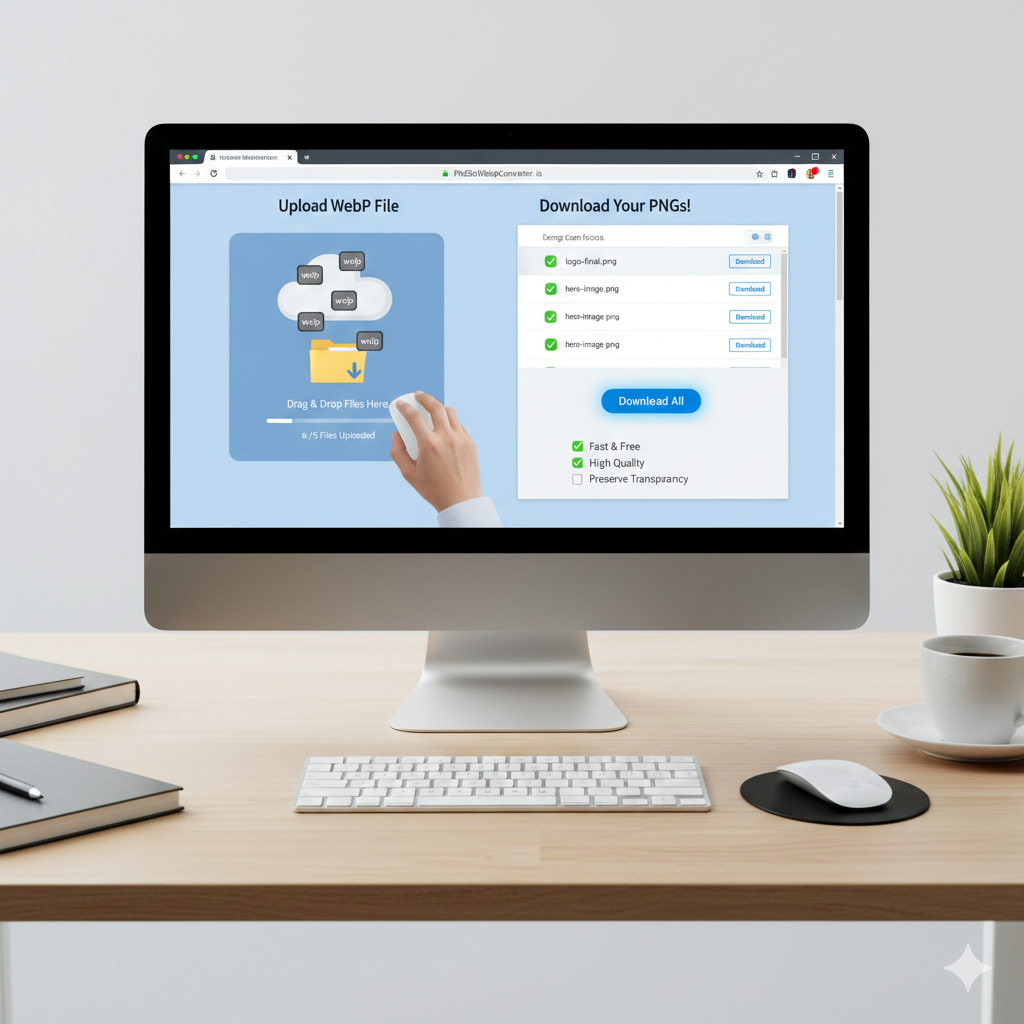
When efficiency and quality are your priorities, using a dedicated cloud-based converter is the best route. Our tool is designed specifically for this task.
The Benefits:
- No Installation: Works entirely in your browser.
- Privacy-Centric: Files are processed and then wiped from the server.
- Batch Processing: Convert 10, 20, or 50 files at once.
- Cross-Platform: Works on Windows, Mac, Linux, iOS, and Android.
How to do it:
- Open PNGtoWebPConverter.io.
- Drag your WebP file to PNG add the upload box.
- Click “Convert.”
- Download the ZIP file containing your new PNGs.
Method 2: The Command Line (For Developers)
If you are a developer managing thousands of files, you might use FFmpeg or ImageMagick. Using ImageMagick, the command is simple: magick mogrify -format png *.webp This converts every WebP in a folder to PNG in seconds.
Method 3: Built-in OS Tools
- On Windows: Open the image in Photos or Paint. Go to Save As and select PNG.
- On Mac: Open in Preview. Hold the Option key while clicking the Format menu in the Export dialog to see all available formats, including PNG.
Technical Deep-Dive – Lossless vs. Lossy
One of the biggest questions we get is: “Will my image look worse after conversion?”
To answer this, we need to understand math. When you convert a WebP file to PNG, you are taking a compressed format and moving it into a “container” that doesn’t lose any more data.
- If the original WebP was Lossless: The resulting PNG will be an exact, bit-for-bit replica of the original.
- If the original WebP was Lossy: The PNG will look exactly like the WebP, but the file size will likely increase significantly. This is because PNG is not as “smart” at hiding data to save space as WebP is.
Pro Tip: Converting a low-quality WebP to a PNG will not “fix” the quality. You cannot create data that isn’t there. It just prevents further loss of quality.
The FAQ
Search engines and AI bots like to pull direct answers for users. Here are the definitive answers to the most common questions regarding WebP to PNG conversion.
Can I convert WebP to PNG without losing transparency?
Yes. Both formats support an “Alpha Channel” (the layer that handles transparency). Our converter at PNGtoWebPConverter.io is specifically coded to detect the alpha channel and map it correctly to the PNG output.
Is WebP better than PNG?
It depends on the context. For website speed, WebP is vastly superior. For graphic design and image editing, PNG is better because of its universal support and lossless nature.
Why did my computer start saving everything as WebP?
Google Chrome and other modern browsers prioritize WebP to save bandwidth. If a website offers a WebP version, the browser will download it by default.
How do I batch convert 100+ files?
Using our online tool is the easiest way for most users. For power users, a script using Python or a command-line tool like ImageMagick is recommended.
The Evolution of Web Standards
To understand why the “WebP file to PNG” search term is so popular, we have to look at the “Web Vitals” update by Google.
A few years ago, Google made “Page Speed” a primary ranking factor. This forced web developers to scramble for ways to make sites faster. The easiest “win” was converting heavy PNG logos and JPEG photos into WebP.
However, this created a disconnect. The Internet speaks WebP, but the Human (and their local computer) still speaks PNG/JPEG. We are currently in a “transition era” where we need tools to translate between the two.
SEO Best Practices for Image Conversion
If you are converting images for your own website, simply changing the format isn’t enough. You should also:
- Optimize File Names: Don’t leave your file named IMG_1234.png. Rename it to best-webp-to-png-converter.png.
- Alt Text: Always add descriptive alt text for accessibility.
- Dimensions: Ensure the PNG isn’t 5000px wide if it’s only being displayed in a 500px box.
- Lazy Loading: Even if you use PNG, ensure your website uses “lazy loading” so images only load when they enter the viewport.
Troubleshooting Common Conversion Issues
Issue: “The converted PNG won’t open.”
Reason: Usually, this happens if the file extension was manually renamed (e.g., changing image.webp to image.png by typing it). This doesn’t change the internal code. Solution: Use a proper converter like PNGtoWebPConverter.io to re-encode the file.
Issue: “The file size is too big.”
Reason: PNGs are naturally larger. Solution: If the file size is a problem, consider converting to a “Compressed PNG” or staying with WebP if compatibility isn’t an issue.
The Future of Image Formats (AVIF and Beyond)
Is WebP the end of the road? No. There is already a new format on the horizon: AVIF. AVIF offers even better compression than WebP. However, AVIF has even less support than WebP currently does. This means the need for conversion tools will only grow over the next decade. Today you need to convert WebP to PNG; tomorrow you might need to convert AVIF to PNG.
Technical Comparison: WebP vs. PNG
To help you decide when to keep a file as WebP and when to convert it to PNG, let’s look at the data.
| Feature | WebP | PNG |
| Compression | Lossy & Lossless | Lossless Only |
| Transparency | Yes | Yes |
| Animation | Yes | No (requires APNG) |
| Browser Support | All Modern Browsers | All Browsers (Old & New) |
| File Size | Extremely Small | Medium to Large |
| Use Case | Web Performance | Design & Printing |
Final Thoughts: Why This Matters
At the end of the day, technology should work for you, not against you. The frustration of an incompatible file format is a barrier to creativity and productivity. By understanding how to convert WebP file to PNG, you take control of your digital assets.
Whether you are a developer trying to satisfy Google’s Core Web Vitals or a student trying to put a picture in a PowerPoint, having a reliable converter in your bookmarks is essential.
Why use PNGtoWebPConverter.io?
- Simple: No learning curve.
- Free: High-quality conversion without the price tag.
- Reliable: Built by experts in image compression.
Ready to fix your image compatibility issues? Convert your first WebP file to PNG right now!